
PEAK PRACTICE
Peak Practice is a community that delivers expert industry insights on how to scale, streamline, and accelerate personal injury law practices. By providing knowledge and resources on law firm operations, marketing, and business growth, Peak helps personal injury attorneys gain a competitive edge. As the leader in lien resolution, Synergy partners with firms to eliminate settlement bottlenecks, optimize client outcomes, and drive greater profitability—so you can focus on securing justice. Join the community here and discover how partnering with Synergy helps you achieve Peak Practice.
Below are our Synergy InSights on all things related to Peak Practice.
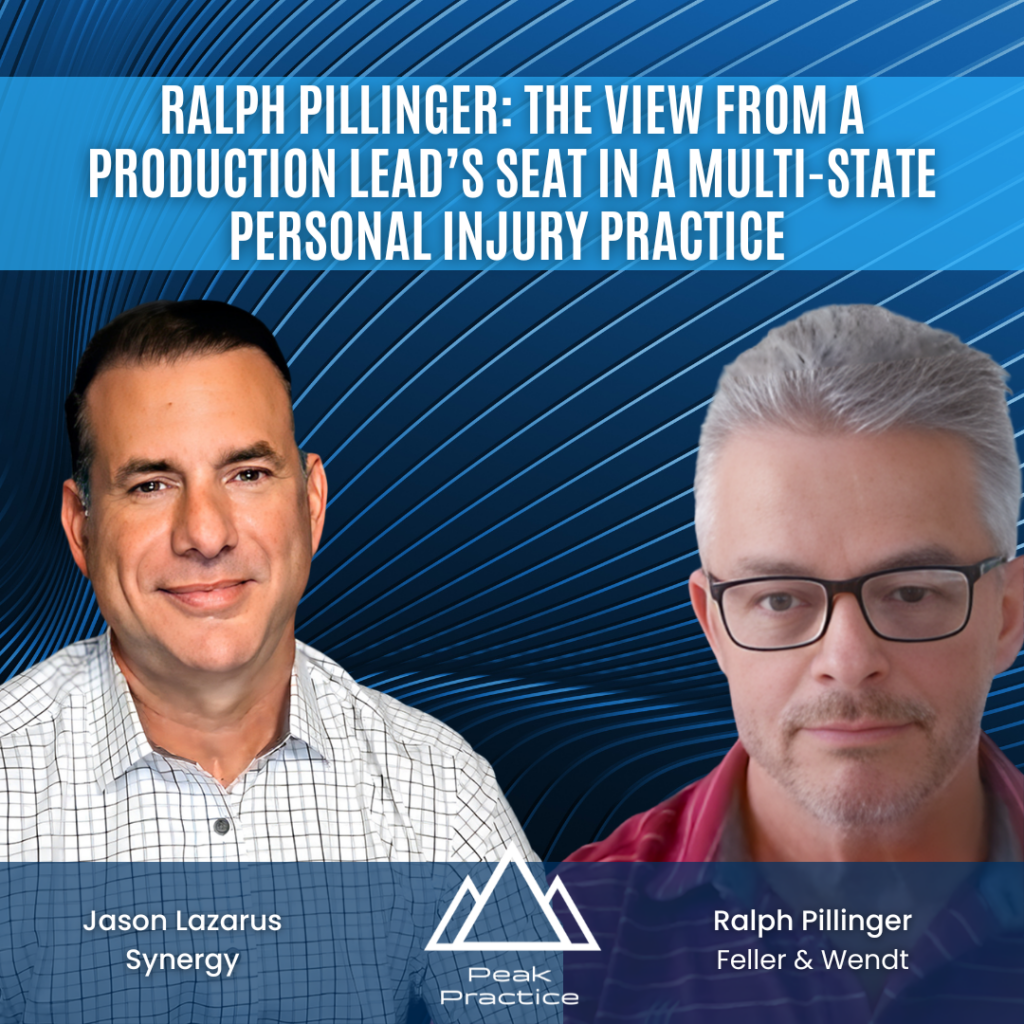
A 24-year litigation paralegal who also coaches endurance athletes explains how the best personal injury firms run operations, set up cases, and use AI without losing the human part of the work.
On the latest episode of the Trial Lawyer View by Synergy podcast, I sat down with Ralph Pillinger, a litigation paralegal and production lead at Feller & Wendt, LLC, a multi-state catastrophic injury firm. Pillinger has spent more than two decades in litigation. He has also led national sales training, worked in financial services, and still coaches endurance athletes on the side. That mix shows up in how he thinks about personal injury law firm operations.
Start with the end in mind, then build the playbook
Pillinger frames almost everything around control. In litigation, you cannot control the weather, the other side, or what a jury does. So, he focuses the team on the one thing they control: the process.
“You need to make sure you have a playbook and you run it no matter what”.
This matters more as you grow. Feller & Wendt went from under 50 employees to over 105 in about a year. That kind of growth breaks firms that run on memory and personality. It rewards firms that run on documented, repeatable processes.
Why a firm at scale needs a production lead
Most personal injury firms have no production lead. Pillinger argues that is a mistake once you cross a certain size threshold. His job is to make sure every team operates at the same level, not only the strongest one.
The role started with a simple observation from his director of operations: not all teams were producing the same way. Pillinger already coached athletes. The firm asked him to coach case teams the same way. His day-to-day work centers on three things:
• Hiring for culture fit first, then matching the profile to the position using tools like predictive index or DISC.
• Putting the right person in the right chair, so the firm uses each person’s strengths instead of fighting their weaknesses.
• Building infrastructure around stated core values, so the team knows what good work looks like at every handoff.
If your firm has more than 50 people and no one owns consistency across teams, you have found a gap worth filling.
The handoff problem most PI firm owners never see
What operational breakdown do paralegals see clearly that PI law firm owners miss? His answer was the gap between the people who interact with the client every day and the people who litigate the case.
Often the litigator comes in at the back end. The intake specialist or case manager had the early contact. When those two don’t properly connect, the firm loses information that drives case value and client trust. The fix is not complicated. The best teams debrief each other and ask what they would do next.
Stop paying your team to do work outside their wheelhouse
Pillinger is direct about lien resolution. He is good at getting reductions. He does not enjoy it, and it takes him (or his team) times longer than a specialist. So, he hands it off and spends that time on high value legal work that moves the needle on case value.
Any task inside a firm that is repeatable and administrative, not high-level legal work, belongs with technology or an outside partner. Lien work, medical record retrieval, and similar functions pull your team away from client contact and case value. Both of those drive better outcomes and better reviews. The team should focus on “what they do best, which is securing justice for people that are injured.”
Coach your team the way you would coach an athlete
This is where Pillinger’s background pays off. He coaches case teams with the same model he uses to take someone from the couch to a 50K trail race. Two questions decide whether someone succeeds:
• Do you believe the coach knows what they are talking about?
• Will you follow the plan even on the bad days, knowing that 160 training days are never all perfect?
Then he adds a third step that most managers skip. He asks how each person wants to be coached. Some want a swift kick. Some want an arm around the shoulder. Some need a soft sell. He asks permission to coach them that way, then holds them to it. Pacing a team that carries complex caseloads works the same as balancing training load with recovery.
AI does 92 percent. The art is the last 8.
Pillinger is a self-taught technology adopter who leans on tech-savvy friends to stay current. His view on AI is grounded, not hyped. He cited a number worth repeating: human review of a 2,000-page document runs about 65 percent efficacy. Depending on the model, AI lands between 85 and 95 percent. He would rather spend his time on the remaining gap than on the bulk of the pages.
AI does 92 percent. The art is the last 8 percent.
He credits trial lawyer Mark Lanier with the framing he repeats often: AI will not replace attorneys and paralegals, but attorneys and paralegals who use AI will replace those who do not. The same is true in almost any industry.
His advice on tools is equally practical. Do not chase the 2,000 products that launch every year. Pick one, learn it deeply, and get firm-wide buy-in. He also warned about how firms buy poolry:
• They over-invest in products the team never tested and never asked for, so no one uses them.
• They under-invest in high-value tools like AI medical chronology, often out of distrust.
His fix: run a pilot, let multiple teams test the options, score them on a shared rubric, and let the people who will use the tool help pick it. That is how you get a real return on the spend.
If one resignation creates chaos, you built a job, not a business
If you are one resignation away from chaos, do you really have a business? You probably created a job for yourself.
The cure is redundancy. Hire people better than you. Delegate real responsibility. Move people into the chairs where they win, then backfill behind them. Pillinger is open about his own goal: he wants to duplicate himself with a production lead in every location so the firm runs without him. He even ran an AI prompt asking what he needed to work on that he did not see in himself. The answer was hard to hear. He chased it anyway.
His closing rule on this is one every leader should sit with: “If you are the smartest person in the room, you are in the wrong room.” Build an inner circle that challenges you. Avoid the yes-people.
What to do with this
If you lead or operate a personal injury firm, here is where to start:
• Find your handoff gaps. Make sure attorneys debrief the people who had first contact with the client.
• Move repeatable admin work off your team. Lien resolution and record retrieval are client costs, not partner time.
• Pick one AI tool and go deep. Run a pilot, get buy-in, and let AI carry the repeatable 92 percent.
• Build redundancy into your firm now. Train and delegate so no single departure breaks the operation.
🎧 Listen to the full podcast conversation on Trial Lawyer View here: https://triallawyerview.com/podcast/ralph-pillinger/
🔗 Want more insights like this?
If you’re a personal injury lawyer ready to scale, streamline, and step into your role as CEO, let’s talk. Join the Peak Practice Community, and learn how Synergy can help you eliminate settlement bottlenecks, resolve complex liens, and maximize recoveries. Learn more here: https://bk-0726.partnerwithsynergy.com/peak-practice/
If you want to grow and scale your law firm more effectively, consider partnering with Synergy for lien resolution. Learn more at: https://bk-0726.partnerwithsynergy.com/liens/
Every personal injury firm is being pitched AI tools right now. Very few are seeing real returns.
A recent MIT study found 95 percent of companies cannot draw a straight line from their AI spend to any measurable result. Uber’s COO admitted the company burned its entire 2026 token budget by April with nothing to show for the money. If a company with Uber’s engineering resources struggles to prove ROI, your firm should approach every AI sales pitch with healthy skepticism.
This is not a reason to sit out. This is a reason to be smarter about what AI does well, where AI fails, and how to evaluate the tools landing in your inbox every week. I have spent the past year talking with technologists and firm leaders on the Trial Lawyer View by Synergy podcast about this exact question. Two of those conversations, one recent one with Shim Hirsh and one with Kyle Wright, shaped the framework below.
The capability overhang problem
Shim Hirsh describes this moment as capability overhang. AI models perform far beyond what most organizations know how to leverage. The question is no longer whether AI handles a given task. The question is whether your firm operationalizes the output. Anthropic and OpenAI have both announced multi-billion dollar investments in integration companies, deploying engineers to help enterprises put AI to work inside their operations. The frontier labs understand something most law firms have not absorbed yet. Intelligent output sitting on a separate platform does not translate into ROI.
What AI does well in PI operations
AI performs best when you give a specific problem, specific instructions, and specific tools, and require a specific output. The high-value applications in PI firms today follow this pattern. Document extraction and summarization across medical records, police reports, and intake transcripts. Intake transcription, so your agents never touch a keyboard and focus entirely on the client conversation. Workflow automation, flagging matters needing action and routing cases to the right person. End-to-end medical record requests, from provider extraction to vendor submission to follow-up. Finding information across thousands of files instantly and moving the data where the work happens.
The common thread is administrative burden. AI absorbs the repetitive work so your people focus on client service and legal work. The same logic applies to lien compliance. Lien identification, verification, and resolution consume enormous staff hours and carry real malpractice exposure when handled poorly. This is exactly the category of work technology with a human in the loop should remove from your team’s plate. At synergy., we built our lien resolution process on this premise, pairing technology with specialists so your paralegals work cases instead of sitting on hold with Medicare contractors.
What AI does badly, and where firms get burned
Shim is emphatic on one point. AI should never talk to your clients. The apparent savings look tempting on a spreadsheet, and the client experience suffers every single time. Injured people hire you because they want a human advocate. Hand the relationship to a bot and you erode the one asset a plaintiff firm cannot replace.
Autonomous case management is a mistake for the foreseeable future. The vision of an AI case manager making decisions and moving files around sounds impressive in a demo and fails in practice. AI is all knowledge and no experience. A model does not understand precedent, weight, or context the way a practitioner does after twenty years of reading adjusters and judges.
Generic AI built into your case management platform deserves the same caution. Built-in features produce average outputs by design. Your firm has its own playbook, case types, jurisdictions, and business model. Generic does not work. The “let AI handle everything” pitch is snake oil. AI builds solutions. AI is not the solution.
The human-in-the-loop imperative
Kyle Wright’s firm offers the model worth copying. AI assists with intake transcription, document population, and workflow automation, and staff clicks, verifies, and approves at every checkpoint. The structure matters as much as the tool. If your system requires users to assign tasks to an AI agent, adoption fails. People forget, skip the step, or do the work themselves. The fix is to flip the direction. Surface completed work to humans for confirmation. Yes, no, or edit.
Staff buy-in matters as much as architecture. Involve your team in technology decisions and explain how their roles change and improve. Without buy-in, even well-built implementations die quietly.
The questions to ask after the demo
Every AI demo looks impressive. Your job starts when the demo ends. First, ask how the vendor got the inputs. Did someone manually key in data? Is there a bot logging into a portal, the kind of integration breaking every two weeks? Second, ask whether you tailor the output. Will the tool reflect your case types, jurisdictions, and business model, or are you getting a generic response dressed up for the sales call? Third, ask where the output lives. Does the result integrate with your case management system and trigger processes, or does the work sit on another platform waiting for someone to retrieve and rekey? Fourth, ask for other clients’ ROI stories and how the vendor proved them. This one question tells you most of what you need to know.
Watch the pricing model too. Do you need medical records review on every case, or only the complex ones?
The integration problem
AI living outside your case management system creates another source of truth, and another place where information goes to die. The real value comes from embedding AI in your existing stack, triggering processes, moving files, and prompting action inside the system your team already uses. Shim estimates 75 percent of the work is not the AI feature at all. The work is the interpretation and orchestration layer. When does the automation fire? Where does the output go? Who gets notified? Building technology is no longer the barrier. Defining the specific problem and operationalizing the output is the barrier.
The operational know-how gap
The firms getting ROI from AI are not the ones with the most tools. They are the ones with operational discipline. You need people who speak your operational language, understand your pain points, and translate those needs into working systems. Those people are expensive and scarce, and right now Anthropic is recruiting them, not your law firm. The practical alternative is partnering with specialists who understand PI operations and sell outcomes rather than software. The same principle drives how we approach lien resolution compliance at Synergy. You should buy a resolved lien, not another login.
A practical starting point
Map your processes before you buy anything. What is step one, step two, step three, and where do people drop off? Identify the administrative tasks pulling time away from client service and legal work. Lien identification/verification, medical record requests, and intake transcription usually top the list. Then start small. Pick one workflow with clear, measurable ROI and prove the result before expanding. Measure adoption, not capability. If your team is not using the tool, sophistication is irrelevant.
The bottom line
AI is an extraordinary tool. AI is not a solution. The firms seeing real returns understand the value sits in operational know-how and business judgment, not technical capability. The question for firm leaders is simple. Are you buying AI tools, or are you solving specific problems with measurable outcomes? The hype will keep coming. The firms cutting through the hype will win.
Why Synergy is the Answer to Help You Scale
Synergy exists to help firms confront the operational realities being driven by technology and scaling pressure. By removing administrative burdens related to lien identification, verification and resolution, from your staff, we help you strengthen your practice’s capacity for high-value legal work and sustainable growth.
🔗 Want more insights like this?
If you’re a personal injury lawyer ready to scale, streamline, and step into your role as CEO, let’s talk. Join the Peak Practice Community, and learn how Synergy can help you eliminate settlement bottlenecks, resolve complex liens, and maximize recoveries. Learn more here: https://bk-0726.partnerwithsynergy.com/peak-practice/
If you want to grow and scale your law firm more effectively, consider partnering with Synergy for lien resolution. Learn more at: https://bk-0726.partnerwithsynergy.com/liens/
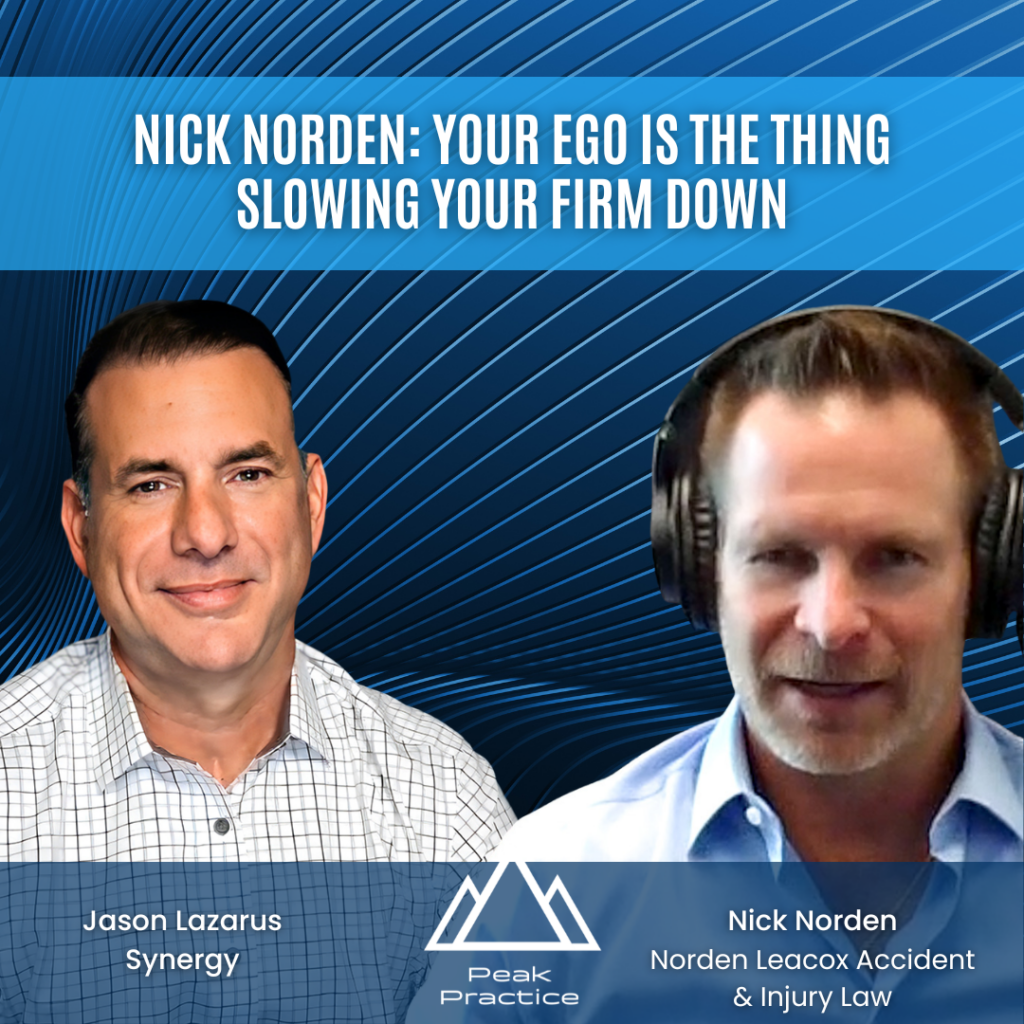
Most trial lawyers think the hard part is winning. You try the case, you get the verdict, you move on to the next one. Then you start your own firm and learn the truth. Winning cases and running a firm are two very different jobs. Being great at one does not make you good at the other.
I sat down with Nicholas Norden, founder of Norden Leacox Accident & Injury Law in Orlando, for a recent episode of the Trial Lawyer View by Synergy podcast. Nick left the defense side, built a true trial firm, and scaled it to seven attorneys. What he shared is a clear playbook for any plaintiff lawyer who wants to grow without grinding themselves into the ground.
Here is what stood out.
Run it like a business from day one
Here is where Nick separates from most firm owners. He has a finance degree. His partner, Zach Leacox, has an MBA. Before they opened the doors, they spent hundreds of hours writing a real business plan. A budget. A marketing plan. One-year, three-year, five-year, and ten-year targets.
Most lawyers do the opposite. They hang a shingle, start practicing, and figure out the business side later. By then they are already behind.
The business mindset shows up most in how Nick makes decisions. He pointed to a trap a lot of smart lawyers fall into:
“In business you learn it is about getting 80 percent of the information and making a decision. A lot of my lawyer friends fall into paralysis by analysis. They want to know every single thing, and then it is too late.”
If you do not have a business background, you do not have to go get an MBA. You do have to treat the firm like the business it is. Know your numbers. Make the call with the information you have.
The ego problem nobody wants to name
This was the sharpest moment in the conversation. Nick and Zach belong to Fireproof Performance, a coaching and mastermind program for PI firms. At one conference, Mike Morse called them out in front of the room. He asked who the best trial lawyer at the firm was. Both Nick and Zach said they were.
Mike told them that answer was the problem. Their egos were the ceiling. If they wanted to scale, they needed to hire trial lawyers who were better than them, then step back and run the business.
“We cannot let our ego get in the way. We have to go find a group of lawyers who care as much as we do and may be better at some things than we are, and let them do it.”
That is the breakthrough for a lot of founder-led firms. You are the bottleneck. Your skill at trying cases is exactly what keeps you trapped in the work instead of building the firm.
Hire on values, fire fast when they do not fit
Nick shared the personnel mistake that cost his firm the most. Early on they kept a high performer who was a poor cultural fit. The person was good at the job, so they held on too long. The result:
• Other team members did not want to work with the person.
• Good people left because of them.
• The whole atmosphere turned negative.
When they finally made the call, the change was night and day. People who had left asked to come back. Now Nick and Zach hire, fire, and train on core values. If someone does not meet the values, skill does not save them.
“You gain the respect of your employees when you do that. They know you will hold people accountable to your core values. That is what they want.”
You cannot do it alone
Nick is candid about the loneliness of ownership. He had an advantage most founders do not. His partner is also his best friend of twenty years, which gives him a sounding board at 10:30 at night when a new worry hits. Most leaders do not have that.
Coaching and masterminds filled the gap. Nick says the three biggest wins from that community were:
• Dashboards and metrics. He now knows his case acquisition cost, lead volume, and conversion rate at any moment.
• Structured meetings. Quarterly and annual planning where the executive team sets goals on paper and holds each other accountable, including the partners.
• Peer camaraderie. A group of firm owners across the country at the same stage, swapping ideas on AI, marketing, and vendors under NDA, with an abundance mindset.
Starting over, he would join sooner. He waited until year two or three. His advice to new owners is simple. Get coaching. If not Fireproof, then someone.
AI is now a requirement, not an edge
Nick does not see AI as a threat to jobs. He sees it as the way his team stops doing tedious work and spends more time with clients. His firm runs case management software with AI layered on top for specific tasks:
• Medical chronologies that used to take a paralegal hours or days now take minutes, with a human checking the output.
• Automated text and client messaging so staff stop doing repetitive outreach by hand.
• Medical records follow-up, where AI chases responses at 7 and 14 days instead of a person tracking every request.
The line he holds is client contact. With a firm their size, human interaction with clients is the thing that sets it apart, so that stays with people. Everything repetitive and administrative is fair game for a tool.
This is the same logic behind why we built our own AI powered lien technology at Synergy. But it is always with human subrogation experts in the loop. As Nick points out, the hours your team spends on hold with Medicare or chasing recovery vendors is time you recapture and deploy to higher-value work.
If a tool does not improve the client experience in the end, it is aimed at the wrong goal.
Key Takeaways from Nick
Nick’s firm prepares every case as if it is going to trial. Because of that, about 99 percent reach a fair resolution without one. The trial readiness drives the outcomes. The business discipline lets the firm survive the volume.
If you are building or scaling a plaintiff firm, the pattern here is worth copying:
• Run it like a business from the first day, not the day it breaks.
• Get your ego out of the way and hire people better than you.
• Protect culture by hiring on values and acting fast when fit is wrong.
• Surround yourself with coaches and peers who tell you what you cannot see.
• Use AI to free your team for client work, not to replace the people who do it.
The firms that get this right are not working more hours. They are building something that lasts.
🎧 Listen to the full podcast conversation on Trial Lawyer View here: https://triallawyerview.com/podcast/nicholas-norden/
🔗 Want more insights like this?
If you’re a personal injury lawyer ready to scale, streamline, and step into your role as CEO, let’s talk. Join the Peak Practice Community, and learn how synergy. can help you eliminate settlement bottlenecks, resolve complex liens, and maximize recoveries. Learn more here: https://bk-0726.partnerwithsynergy.com/peak-practice/
If you want to grow and scale your law firm more effectively, consider partnering with Synergy for lien resolution. Learn more at: https://bk-0726.partnerwithsynergy.com/liens/
Plaintiff firms often hit a ceiling because of operations, not casework. Strong verdicts hide weak systems, until Why the firms winning with legal AI are not the ones with the most tools, but the ones who brought their teams along.
Every trial lawyer I talk to is being pitched an AI tool right now. Intake bots, document drafting platforms, demand letter generators, etc. Technology has become incredibly useful in the last eighteen months. The pitches have gotten more forceful in terms of not being left behind. What I notice is the gap between firms buying AI and firms benefiting from AI. The buyers are everywhere. Beneficiaries are more rare.
Kyle Wright put it plainly on a recent episode of the Trial Lawyer View podcast: “I’ve wasted money on different products that just didn’t end up working for us.” He runs a busy plaintiff practice and knows what he is talking about. His mistake was not buying the wrong software. His mistake was buying first and figuring out how his team would use it second. That order of operations is what separates the firms scaling with AI from the ones writing off the spend.
Why most law firm AI rollouts stall
There are four common failure patterns that are developing among personal injury practices:
First, the shop-and-drop mistake. A firm leader attends a conference, watches a vendor demo, signs a contract, and announces the tool to staff in a Monday email. The people expected to use it had no say in the selection. They have every reason to ignore it.
Second, the replacement fear. Paralegals and intake staff read the marketing copy on AI legal tech and hear one message: you are next. Even when the firm’s intent is to augment the work, the message lands as a threat. Adoption dies before it starts.
Third, the workflow mismatch. The tool was built for a generic firm. Your firm is not generic. The software demands a process your team does not use on a schedule that does not match how your cases move through the firm. The renewal comes due, and no one will admit they stopped using it months ago.
Fourth, no feedback loop. Leadership assumes the tool is working because no one is complaining. Staff are not complaining because no one asked. Six months in, the firm has paid for a product nobody is using.
What human-in-the-loop actually means
The phrase gets thrown around loosely. Here is the working definition I use with our clients at Synergy: Human-in-the-loop means AI handles the volume work and humans verify and decide at every consequential checkpoint. The software does the initial heavy lift. A person reviews before it goes to a client. The model flags a possible Medicare conditional payment. A trained subrogation specialist confirms the existence and validity before action. The system with a human in the loop produces a verified claim summary from the lien holder.
This matters for two reasons that operate at the same time:
The first is quality control. AI makes confident errors. It hallucinates case citations, transposes numbers, and pulls the wrong client’s name from the system more often than the vendor demos suggest. A reviewing human is your protection against the version of those errors that end up in front of a judge or a client.
The second is staff engagement. People stay invested in their jobs when the work routes through them at points where judgment matters. The minute you push humans out of the decision points; you have told them their judgment is optional. They will respond accordingly.
The buy-in process experts recommend
The firms succeeding with AI follow a recognizable sequence. None of it is complicated.
Bring staff into the evaluation before you buy. Sit your case managers, paralegals, and intake leads in on the demos. Ask them what would save them time. Ask them what they would refuse to give up.
Explain what their role will look like after the tool goes live. Be specific. “Your morning will start with reviewing the system’s intake summaries instead of transcribing the calls yourself. That gives you back two hours a day to focus on case strategy and client communication.” That sentence does more for adoption than any training session.
Pilot with a small group. Two or three people, one workflow, sixty days. Iterate based on what they tell you. Then expand.
Celebrate the wins as team wins. When the tool cuts demand letter drafting time in half, the firm announcement should name the paralegals who refined the prompts and the intake staff who cleaned the source data. Technology did not save the firm time. Your people did, with help from technology.
What to automate and what to keep human
The high-value targets for automation in a PI practice are clear, repetitive administrative tasks that take time away from high level legal work or client interactions. Intake call transcription and summary. Medical record review and chronology building. Document population. Routine status correspondence to clients. Initial demand letter drafts. Discovery response drafts. Deposition summaries. Lien identification and verification. Each of those tasks is a tax on staff time that pulls them away from work requiring legal judgment/human input. The work that stays with humans is also clear. Client communication on substantive issues. Legal strategy. Negotiation. Quality review of any AI-generated document before it leaves the firm.
There is a third category worth pulling out separately. Some administrative work is too specialized for general-purpose AI and too time-consuming for in-house staff to do well. Lien identification, verification, and resolution are the clearest example I deal with daily. Medicare conditional payments. Medicare Advantage and Part D recovery. ERISA plan subrogation. Hospital and provider liens. State Medicaid recovery. Each one has its own statutory framework, its own portal, its own negotiation posture.
When firms try to handle that work internally, even with AI assistance, two things happen. Cases sit at the disbursement stage for weeks while staff chase down lien holders. And the firm leaves money on the table because the people negotiating are not specialists in the rules. Outsourcing that work to a team built for it is not a cost. It is a release of staff hours back to the legal work that moves cases forward. Pair that with the right technology stack, and the math gets favorable quickly.
Build for continuous improvement, not perfection
Technology rollouts in law firms are treated as projects with end dates. That framing is the problem. Create feedback channels staff will actually use. A shared document where anyone flags what is broken, what is missing, what is slowing them down. A standing fifteen-minute item on the weekly team meeting. Nothing elaborate. The point is that staff know their input goes somewhere.
Run quarterly reviews of every AI tool you have licensed. What was the intent. What is the current usage. What needs to change. Cancel what is not working without making it a referendum on the people who pushed for it. Keep what works and double down.
As an example, an AZ firm I respect for their operational discipline, treats their FileVine stack as a permanent work in progress. They refine constantly. New automations, new triggers, new fields, retired workflows. The mindset is that the system gets better every month because someone is paying attention. That is the model.
The real question for firm leaders
The firms that win with AI over the next three years will not be the ones with the most subscriptions. They will be the ones with the cleanest implementation. Selection discipline, staff buy-in, continuous refinement. Boring, repeatable practices.
Staff buy-in is the line between a tool that compounds value and a tool that becomes a line item nobody defends at renewal. Technology is not the bottleneck anymore. The implementation is.
So, the question worth sitting with this week. Are you bringing your team into the technology decisions that affect their work, or are you telling them what is coming and hoping for the best?
The firms scaling are doing the former. The ones still struggling with adoption are doing the latter.
Why Synergy is the Answer to Help You Scale
Synergy exists to help firms confront the operational realities being driven by technology and scaling pressure. By removing administrative burdens related to lien identification, verification and resolution, from your staff, we help you strengthen your practice’s capacity for high-value legal work and sustainable growth.
🔗 Want more insights like this?
If you’re a personal injury lawyer ready to scale, streamline, and step into your role as CEO, let’s talk. Join the Peak Practice Community, and learn how Synergy can help you eliminate settlement bottlenecks, resolve complex liens, and maximize recoveries. Learn more here: https://bk-0726.partnerwithsynergy.com/peak-practice/
If you want to grow and scale your law firm more effectively, consider partnering with Synergy for lien resolution. Learn more at: https://bk-0726.partnerwithsynergy.com/liens/
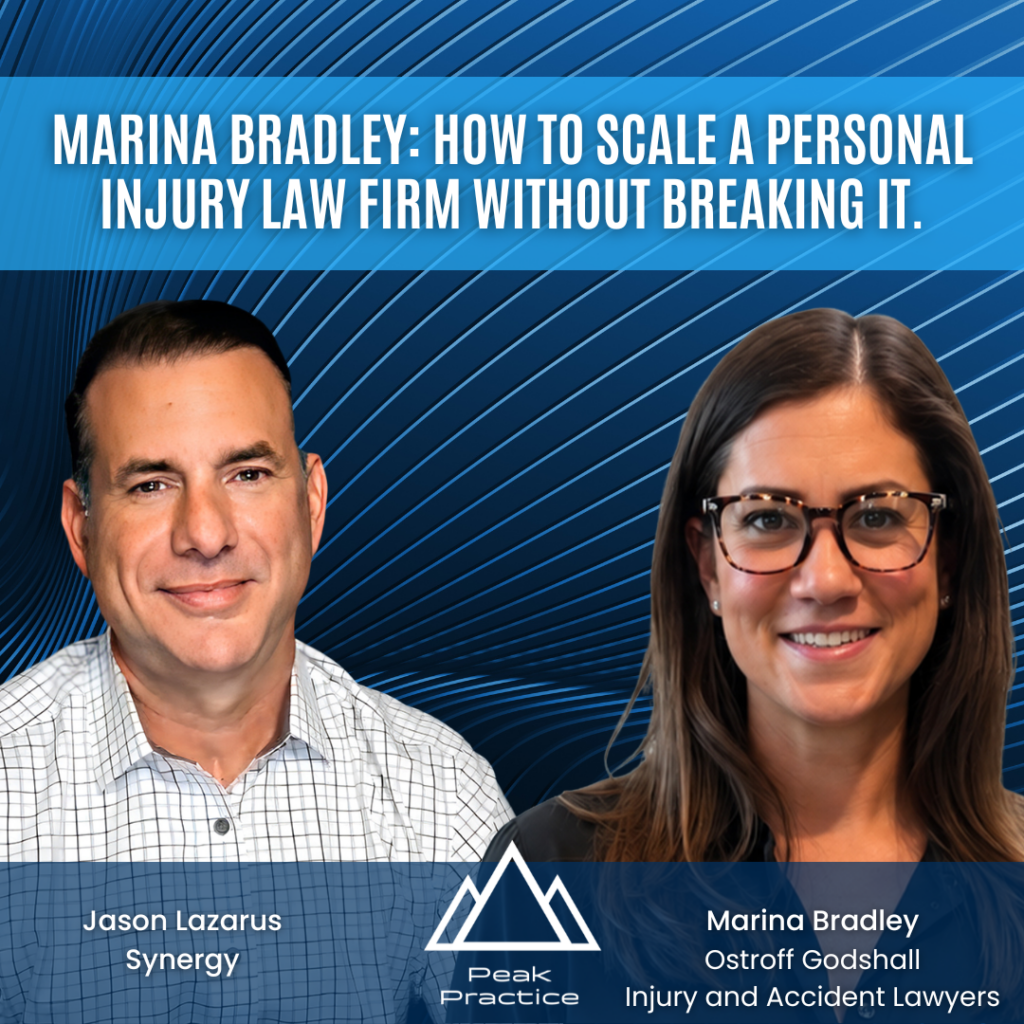
Plaintiff firms often hit a ceiling because of operations, not casework. Strong verdicts hide weak systems, until volume forces every weakness to the surface. Marina Bradley, Executive Director at Ostroff Godshall Injury and Accident Lawyers, sat down with me on a recent episode of the Trial Lawyer View by Synergy podcast to talk through what scaling looks like when you stop guessing and start measuring. Here are the highest-value ideas from the conversation for trial lawyers building a real firm behind their results.
The Executive Director role most PI firms are missing
The Executive Director seat at a personal injury firm is still being defined. Most plaintiff firms run on the traditional managing partner model, where the lawyer who loves trying cases ends up running HR, intake, and finance by default. Marina’s role exists because someone has to own the operational side so trial lawyers stay focused on the work they were hired to do.
“It’s even hard to admit you need help sometimes,” she said. The work starts with separating founder-level tasks from leadership tasks built around the business itself.
Hire ahead of the need
One of the biggest mistakes Marina sees in plaintiff firms is reactive hiring.
“You can’t wait until you need the paralegal to hire the paralegal. You have to have that paralegal training six months before.”
The fix is forward-looking workforce planning. Watch file counts. Watch phone volume. Train the next role before the gap becomes a fire.
The metrics worth tracking weekly
Marina sends a firmwide scorecard every week. No mysteries. No leadership-only data. Everyone sees the same numbers and rows in the same direction. The four she watches most closely:
- Signed cases, split between marketing-sourced and referred
- Complaints filed
- Demands sent out
- Resolution, both pre-lit and in litigation
Monthly, she tracks cost per case and average fee. About 30 percent of OG’s cases move into litigation, which explains a higher average fee and a deliberate choice to file cases.
Time on desk is where the money hides
If you want to find quiet revenue inside your firm, look at time on desk.
“If you cut a couple of months off the time on desk, you’re putting revenue in the previous year. You’re doing 14 months of revenue in 12 months.”
Lien resolution sits inside this problem. Cases stall while medical liens, Medicare obligations, and reductions get worked through. Clients wait. Five-star Google reviews die in the gap between settlement and check.
Intake is the most expensive operational leak
Ask Marina where plaintiff firms lose the most money, and she points straight at intake.
“One call could be a $5 million case.”
Her position: staff intake heavier than feels comfortable. Train constantly. Listen to the recordings. Coach the conversations. Intake feeds every other metric on the scorecard, because nothing moves without the signed case.
Culture as a hiring filter
Ostroff Godshall built core values and a social contract the partners stand behind. Those values drive interviews. Predictive Index assessments help match personality to role.
The lesson Marina learned the hard way: a high-performing hire who fails the culture test pulls the rest of the team down. Her rules are simple. Hire for traits. Train for skill.
The view from the operations seat
The competitive picture is shifting fast for plaintiff firms:
· MSOs backed by private equity entering more markets
· AI tools rewriting how cases get litigated
· Marketing spend climbing in every major metro
· Gen Z workforce expectations reshaping how teams operate
Marina’s response is to focus on what you control. For her firm, that looks like a client experience built on real human contact, with automations used to free up calls rather than replace them. Community presence matters too. Her firm gave away 1,000 backpacks last year and plans to give more this year.
“Grit” is one of OG’s core values, and Marina lives it
If she were building a personal injury firm tomorrow with a goal of 30 lawyers, her first three priorities would be:
· Document every process so the founder’s knowledge lives outside their head
· Lock down cybersecurity, secure phones, and secure email
· Write an AI policy before the team starts using tools without guardrails
The takeaway for plaintiff firm leaders
Operations is the difference between a firm with great verdicts and a firm with a great business. Build the foundation, measure the numbers, protect the intake, and keep the human side of the work alive.
🎧 Listen to the full podcast conversation on Trial Lawyer View here: https://triallawyerview.com/podcast/marina-bradley/
🔗 Want more insights like this?
If you’re a personal injury lawyer ready to scale, streamline, and step into your role as CEO, let’s talk. Join the Peak Practice Community, and learn how Synergy can help you eliminate settlement bottlenecks, resolve complex liens, and maximize recoveries. Learn more here: https://bk-0726.partnerwithsynergy.com/peak-practice/
If you want to grow and scale your law firm more effectively, consider partnering with Synergy for lien resolution. Learn more at: https://bk-0726.partnerwithsynergy.com/liens/

Section 111 of the Medicare, Medicaid, and SCHIP Extension Act of 2007 requires liability insurers, no-fault insurers, workers’ compensation carriers, and self-insured entities to report settlements, judgments, and awards involving Medicare beneficiaries to CMS. The reporting captures the beneficiary’s identity, the settlement details, and the ICD codes that define the injury, giving CMS the data it needs to enforce the Medicare Secondary Payer Act and recover conditional payments. The original 2007 statute imposed a mandatory civil money penalty of $1,000 per day per claim for noncompliance, with no discretion given to CMS. The SMART Act of 2013 changed that mandatory penalty to a discretionary one, capped the daily amount at $1,000, and directed CMS to publish regulations setting out when and how penalties would be imposed. Those regulations became applicable on October 11, 2024, and the first audits and informal notices arrived in 2026, which is why the penalty regime that has sat dormant for nearly two decades is finally live.
The first informal notices of intent to impose civil money penalties under Section 111 of the Medicare, Medicaid, and SCHIP Extension Act began mailing in March. CMS closed its second quarterly audit cycle on April 1. The trade press has framed all of this as an insurer compliance issue. That framing is wrong. Acting on it will cost plaintiff firms money, time, and client outcomes over the next twelve months.
I have spent almost two decades working with trial lawyers on Medicare Secondary Payer compliance. I have watched every false start CMS made on enforcement going back to 2007. This one is different. The audit process is running. The penalty exposure is significant. And the pressure falls hardest on plaintiff lawyers, even though plaintiff lawyers are not the ones being audited.
Here is what is actually happening, and what to do about it.
Where Things Stand This Week
Here is the timeline without the regulatory clutter. October 11, 2024, was the date CMS implemented the final rule for Civil Money Penalties for Section 111 reporting. Since there is a 12-month window in which to report a Total Payment Obligation to Claimant (TPOC) or Ongoing Responsibility for Medicals (ORM), a civil money penalty could not be assessed until October 11, 2025. Reports that should have been filed by then but were not, are now exposed.
CMS opened the first random audit in early 2026. The agency pulls 250 records per quarter, 1,000 per year, across both group health and non-group health plan reporting. Selection is random. The 250 records are drawn from the entire universe of accepted records, not from each Responsible Reporting Entity.
The first informal notices of intent to impose a penalty went out in March. RREs have 30 days to respond with mitigating evidence. If the response is rejected or absent, CMS issues a Notice of Proposed Determination and the formal process begins.
The tiered penalty itself runs from $250 per day per record up to $1,512 per day after the January 2026 inflation adjustment. The single-instance cap at this time is $551,880.
Workers’ compensation TPOC enforcement, including the new WCMSA reporting fields that went live April 2025, are in full scope starting in July.
That is where things stand. Now the part that has been missed.
Why This Is a Plaintiff Problem
The carrier is the entity at risk of a penalty. The plaintiff is the entity that absorbs every operational change the carrier makes to avoid the penalty. There are five specific ways this hits your practice right now.
First, settlement checks are going to sit longer. Carriers will not release funds until they are confident the reporting record is locked and clean and Medicare liens resolved. If you have built your firm’s cash flow assumptions around a 30-day disbursement window, plan for longer. The check is a downstream event of a process you do not control.
Second, ICD diagnosis code overreporting will get worse. A carrier facing $1,512 per day in penalty exposure will report a broader set of codes. That broader code set is what Medicare uses later to deny your client’s future injury-related care. The carrier’s compliance protection may become your client’s coverage problem after the case closes.
Third, release language is already getting more punitive. Hold harmless clauses, indemnity provisions, and reporting cooperation requirements are showing up in releases that did not have them six months ago. Much of this is unnecessary as a matter of law. All of it shifts risk to the plaintiff. The technical reality is that nothing in the MSP requires most of what defense counsel asks plaintiffs to sign. The practical reality is that defense counsel asks anyway, and many plaintiffs sign without pushing back.
Fourth, information demands are now formal and documented. The CMS safe harbor allows the RRE to document a refusal by the beneficiary or counsel to provide a Medicare Beneficiary Identifier or Social Security Number. That documentation is retained for at least five years. If a coverage dispute arises later, the refusal becomes evidence.
Fifth, workers’ compensation closures get harder in July. The new WCMSA reporting fields are about to be tracked for penalty purposes. Lump sum settlements that relied on informal MSA assumptions or below-threshold treatment will draw scrutiny they did not draw last year.
What to Change This Month
Most of the fixes are process work, not legal theory. They are also things every trial lawyer handling cases with Medicare beneficiaries should already be doing. The penalty era just raises the cost of not doing them.
Build Medicare beneficiary screening into intake. Pull the Medicare card, the SSDI award letter, and the MBI at the start of the case, not at the end. Do not let the carrier control the timing or the data flow. Update the Medicare beneficiary screening during the life of the case.
Negotiate ICD codes that will be reported before you sign the release. Get a closed list in writing. Push back on any code that is not directly injury related. The carrier will resist. Make them resist on the record.
Strip boilerplate Medicare compliance language from releases. Most of it cites statutes and regulations that do not say what defense counsel claims they say. A core set of provisions can address the real Medicare issues in one paragraph without onerous obligations on the plaintiff.
Open the Benefits Coordination and Recovery Center conditional payment file before settlement, not after. Final demand timing is now a settlement gating item. The conditional payment letter is preliminary and does not bind Medicare. Only the final demand binds. If you disburse on a CPL, you will pay the difference yourself.
Document everything. If your client declines an MSA, why. If the carrier asks for information, you decide not to provide, document the reason and the law you relied upon. The file should tell the story without you in the room.
The Strategic Point
The penalty era pulls every party in a Medicare case toward earlier and more careful work. The trial lawyers who treat Section 111 as an insurer compliance problem will give up leverage they did not know they had, and they will hand control of the record to the people on the other side of the table.
The trial lawyers who get ahead of it will close cases faster, protect their clients’ future Medicare access, and avoid the malpractice exposure that comes with watching someone else drive the process.
At Synergy, we have spent years helping firms rebuild their MSP intake and settlement workflows for this environment. The cost of getting the process right is small compared to the cost of getting it wrong on a single catastrophic case. The harder problem is that most firms do not yet realize the environment has changed.
The next call you should make on this is internal. Find out who in your firm owns Medicare compliance. If the answer is no one, that is the first thing to fix.
Why Synergy is the Answer to Help You Scale
Synergy exists to help firms confront the operational realities being driven by Medicare compliance pressure. By removing administrative burdens related to Medicare compliance, lien identification, verification and resolution, from your staff, we help you strengthen your practice’s capacity for high-value legal work and sustainable growth. Learn more at https://bk-0726.partnerwithsynergy.com/medicare-compliance/
🔗 Want more insights like this?
If you’re a personal injury lawyer ready to scale, streamline, and step into your role as CEO, let’s talk. Join the Peak Practice Community, and learn how Synergy can help you eliminate settlement bottlenecks, resolve complex liens, and maximize recoveries. Learn more here: https://bk-0726.partnerwithsynergy.com/peak-practice/
If you want to grow and scale your law firm more effectively, consider partnering with Synergy for lien resolution. Learn more at: https://bk-0726.partnerwithsynergy.com/liens/
BLOGS
READY TO SCHEDULE A CONSULTATION?
The Synergy team will work diligently to ensure your case gets the attention it deserves. Contact one of our legal experts and get a professional review of your case today.
